
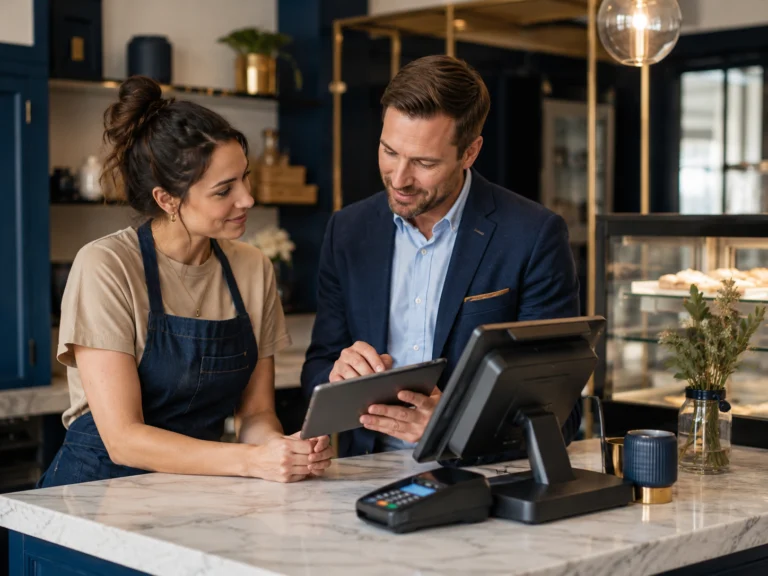
A restaurant POS is tested during the busiest part of the shift, not during a quiet demonstration. Reliability, training, checkout speed, and support all need to hold up when tables turn quickly. In Dunwoody, the practical requirements vary across restaurants, professional offices, retail centers, and service businesses working around Perimeter-area commercial districts. We first examine the current customer journey, staff responsibilities, transaction volume, and payment locations. That discovery gives us a grounded basis for discussing restaurant payment processing without forcing the business into a generic package.
Implementation Without Unnecessary Disruption
Implementation starts with evidence rather than assumptions. We review statements or projections, transaction methods, customer expectations, and the problems behind the search. After the account and technology are matched, we configure the essential settings and walk the team through normal and unusual transactions. The objective is a controlled launch with support already identified, not a hurried activation followed by uncertainty. For this Dunwoody project, we keep the sequence tied to the goal to protect the guest experience during payment. Our hands-on approach is reflected in meet our payment specialists.
Dunwoody’s restaurant market is anchored by the Perimeter Center influence: weekday lunch volume driven by the 100,000-plus daily commuters from Perimeter’s office towers is the defining transaction pattern for restaurants along Hammond Drive, Ashford-Dunwoody Road, and the Perimeter Marketplace area. Evening service patterns are different ( slower, longer average tabs, more wine and cocktail spend ) meaning the restaurant’s payment environment needs to handle both a fast-throughput lunch and a sit-down dinner service efficiently. Dunwoody’s cluster of upscale dining options near the Perimeter area generates high-average-ticket card-present transactions where the card type mix skews heavily toward corporate and rewards cards that carry premium interchange rates. Georgia’s Dram Shop Act creates liability for restaurants that serve intoxicated patrons who subsequently cause harm, and integrated payment systems that track alcohol purchases separately can help document responsible service. Dunwoody’s delivery business, fed by the office park concentration, requires restaurants to reconcile third-party platform payouts against their own POS data , a process that’s cleaner when the in-house system has multi-channel revenue tracking built in. TWC Payments sets Dunwoody restaurants up with accounts that accommodate both the weekday corporate lunch volume and the evening dining mix without penalizing the business for transaction pattern variation from day to day.
Define the Real Business Requirement
We start with the payment moments creating the most friction for a Dunwoody operator that wants modern equipment and straightforward account terms without losing personal service. During this restaurant merchant services review, we ask where customers pay, who handles refunds, how deposits are checked, and which steps staff complete manually. Those answers help us separate pricing concerns from equipment, remote collection, reporting, security, and support needs. They also keep the recommendation tied to the page-specific priority that the end of the meal should feel as organized as the rest of service, rather than to a generic feature list. The available approaches are summarized in our payment solutions overview.
A Practical Payment Setup
For restaurants, cafes, bars, and food-service teams in Dunwoody, the core objective is payment processing that supports the pace of food service so the business can protect the guest experience during payment. The setup is shaped by account approval and selected technology, though we typically review these functions:
- Evaluate counter, tableside, pickup, and delivery payment needs
- Support tipping, receipts, split payments, and refunds
- Choose equipment that fits the service environment
- Train staff before peak service
The final feature set depends on the approved account and selected technology. Our preference is a focused configuration the team understands, not a costly collection of unused add-ons. For restaurants, cafes, bars, and food-service teams in Dunwoody, the deciding standard is whether the setup supports the goal to protect the guest experience during payment.
A Realistic Dunwoody Business Scenario
Dunwoody sits beside a major Perimeter business district and supports restaurants, professional offices, healthcare providers, retailers, and service companies that interact with both local residents and regional customers. A payment system may need to support a busy lunch period, a professional invoice, a recurring client relationship, and mobile acceptance without making reporting fragmented. To protect the guest experience during payment, we consider the physical payment point, peak periods, ticket size, staff movement, and the distance between the office and customer. A counter-focused setup may not fit a team covering Dunwoody and the wider Perimeter business area. Local context matters because those operating conditions directly affect restaurant merchant services, not through repeated location language.
Understand the Full Cost, Not One Rate
A business protects margin by comparing complete systems. Transaction pricing is important, but so are device costs, subscriptions, support, funding, compliance charges, and the labor required to manage the process. We bring those factors into the same conversation. The goal is not to manufacture savings on paper; it is to determine whether the proposed account offers a clearer and more efficient financial fit under realistic operating conditions. In this case, the comparison is framed around the end of the meal should feel as organized as the rest of service. For a direct account conversation, request a custom payment review.
Why Our Service Model Matters
Our model is built around transparent, worry-free commerce. We provide an apples-to-apples review, recommend technology according to the business, assist with setup and staff training, and stay accessible after launch. We do not rely on a long contract or early termination fee to hold the relationship together. For a Dunwoody owner, that means a named relationship stands behind the system. We discuss funding expectations before launch; next-day deposits are available to qualifying accounts, subject to approval and account conditions. Our role is to explain the fit honestly, including situations where a change would add little practical value. More context on our service model appears in why businesses choose TWC Payments.
Helpful Resources for Business Owners
A provider conversation carries more weight when the business brings independent context to it. For this Dunwoody review of restaurant merchant services, the following official and industry resources provide useful background on local operations, security, finance, or the payment channel itself:
- City of Dunwoody resources
- S. Small Business Administration financial management guidance
- PCI Security Standards Council merchant guidance
- Federal Reserve information on payment services
TWC Payments also serves restaurants and food service businesses in nearby Georgia communities, including Smyrna and Duluth. For a complete overview of what we offer the restaurant industry, visit our restaurant payment solutions page.
Frequently Asked Questions
Q: Which restaurant workflows should be tested before launch?
A: We test the tasks that matter during service: opening and closing checks, tips, refunds, voids, permissions, receipt options, closeout, and manager review. The exact functions depend on the selected system. Staff should practice realistic scenarios before a busy shift so the new process is familiar when speed and accuracy matter most. For a Dunwoody operation, we connect that answer to the way the business serves customers across its actual sales area.
Q: Can one setup support counter service and table service?
A: That depends on the restaurant’s workflow and selected technology. We review where orders begin, where guests pay, how servers move, whether checks are split, and how tips are handled. The recommendation should fit the service model instead of forcing every restaurant into the same hardware arrangement or checkout sequence. During a Dunwoody review, we apply this guidance to the business’s real transaction flow rather than a hypothetical setup.
Q: What should a Dunwoody restaurant compare beyond processing rates?
A: Restaurants should also examine equipment reliability, support access, user permissions, tip handling, refunds, reporting, funding expectations, setup assistance, and account terms. A low headline rate has limited value if the system slows service or employees cannot get help during operating hours. We compare the complete operating impact. The recommendation is then documented around the Dunwoody team’s roles, payment locations, and customer expectations.